Skip to content
 Play Music, Express Yourself, Be Happy! 

SAX TEACHER UK

Cannonball Adderley Transcription — Straight No Chaser

By SaxTeacher UK on 10 min read
SaxTeacher UK — author photo

Here is a free transcription of Cannonball Adderley's extraordinary alto saxophone solo on Straight No Chaser — the Thelonious Monk blues classic, taken from the legendary Cannonball Adderley Quintet in San Francisco album recorded live in 1959. This is one of the greatest jazz saxophone solos ever recorded: a masterclass in blues phrasing, packed with exciting punchy vocabulary, imaginative rhythmic content and a brilliant sense of pacing and melodic development. There is a huge variety of articulation and phrasing in this solo, even by the outrageous standards that Cannonball sets on every performance. He plays with lots of different feels and rhythmic subdivisions, so there is a huge amount of depth and detail to explore. The full transcription is available as a free PDF download, along with Straight No Chaser lead sheets in Concert, Bb and Eb.

Study the Man, Not Just the Notes

Cannonball Adderley was one of the most exciting improvisers in jazz history. Read about his background and musical language before diving into the transcription — understanding who he was makes the music make more sense.

Listen, Then Transcribe

Remember that transcribing an improvised solo is primarily an aural activity, not an exercise in reading. Always try to do as much as possible from the recording itself, and only use this transcription if you are really stuck on a phrase.

Newsletter

Get Free Sheet Music & Tips

Tips, tutorials & new posts delivered to your inbox. No spam, unsubscribe any time.

We are committed to protecting your privacy. We will never collect information about you.

Cannonball Adderley — Biography

The Greatest Alto Saxophonist of the Hard Bop Era

Julian Edwin Adderley was born in Tampa, Florida on 15 September 1928 into a musical family — his father Julian Carlyle was a guidance counsellor and cornet player, and his mother Jessie Johnson was an elementary school teacher. The nickname 'Cannonball' — a corruption of 'cannibal,' a childhood reference to his enormous appetite — stuck with him for life. He grew up playing alongside his brother Nat, who would become his long-time musical partner on cornet. After studying at Florida A&M University and teaching high school band in Fort Lauderdale, Cannonball moved to New York in 1955, where his explosive debut sitting in with bassist Oscar Pettiford at the Café Bohemia caused an immediate sensation. Critics hailed him as the heir to Charlie Parker — a comparison that was both flattering and a burden he would spend years moving beyond.

His time with the Miles Davis Sextet from 1957 to 1959 — alongside John Coltrane — cemented his reputation as one of the finest alto saxophonists in jazz history. His playing on the landmark albums Milestones and Kind of Blue showcased a warm, soulful tone and a rhythmic vitality that was uniquely his own. Miles Davis himself noted that Cannonball's blues-rooted alto saxophone against Coltrane's harmonic, chordal approach created a powerful new kind of feeling. Where Parker was angular and harmonically complex, Cannonball was earthy, bluesy and deeply swinging, with an extraordinary ability to build solos that told a story from beginning to end. He also recorded the classic album Somethin' Else for Blue Note in 1958, featuring Davis as a sideman.

After leaving Miles, Cannonball formed his own quintet with Nat Adderley on cornet, Bobby Timmons on piano, Sam Jones on bass and Louis Hayes on drums — the group that recorded the legendary Cannonball Adderley Quintet in San Francisco album in 1959. His later career saw him embrace soul jazz and funk influences, with pianist Joe Zawinul writing the crossover hit 'Mercy, Mercy, Mercy' in 1966, which reached number 11 on the Billboard charts. Cannonball Adderley died on 8 August 1975, aged 46, leaving behind one of the most joyful and virtuosic legacies in all of jazz.

Straight No Chaser — The Tune and the Solo

A Thelonious Monk Blues Classic

Straight No Chaser is a 12-bar blues in concert F composed by Thelonious Monk. Monk first recorded it in 1951, and the tune's distinctive melody — built around a chromatically inflected blues riff — has made it one of the most widely played jazz standards and a favourite vehicle for improvisers ever since. The 12-bar blues is one of the most fundamental chord progressions in jazz and popular music, built around the I, IV and V chords of a key, and mastering it is essential for any improvising musician. If you're working on your blues vocabulary, compare Cannonball's approach here with other blues-based transcriptions on the site.

This transcription is taken from the Cannonball Adderley Quintet's legendary live recording at the Jazz Workshop in San Francisco from 1959, released on Riverside Records as Cannonball Adderley Quintet in San Francisco. The band — Cannonball on alto saxophone, Nat Adderley on cornet, Bobby Timmons on piano, Sam Jones on bass and Louis Hayes on drums — was one of the tightest and most exciting groups in jazz. Cannonball's solo on this track is a masterclass in blues phrasing, rhythmic variety and melodic development, building from relatively simple opening statements to passages of extraordinary virtuosity and intensity. A free Straight No Chaser lead sheet is available for download in Concert, Bb and Eb transpositions in the downloads section below.

Articulation in Cannonball Adderley's Solo

What Makes This Solo Special

The real depth and intricacy of this solo is in the feel, phrasing and articulation. You'll need to spend hours and hours with the recording to learn this. In the score the articulation and accents are outlined as best as possible, but this is really only a rough sketch. His expression with all the different kinds of accents — the play between breath control and tonguing — is extremely complex, especially in the 16th note passages.

There is a huge variety of articulation and phrasing in this solo, even by the outrageous standards that Cannonball sets on every solo. He plays with lots of different feels and rhythmic subdivisions — from lazy, laid-back blues phrases to explosive 16th-note runs that seem to pour out of his horn with impossible fluency. The contrast between these different rhythmic feels is one of the things that makes this solo so exciting to listen to and so rewarding to study.

Pay particular attention to how Cannonball builds intensity across the solo. He paces his ideas brilliantly, starting with simpler, more spacious phrases and gradually increasing the complexity and energy. This kind of storytelling — the arc of a solo — is one of the most important things you can learn from studying a great improviser.

Cannonball Adderley Transcription — Straight No Chaser

Full Score — Alto Saxophone Solo (Free Sheet Music)

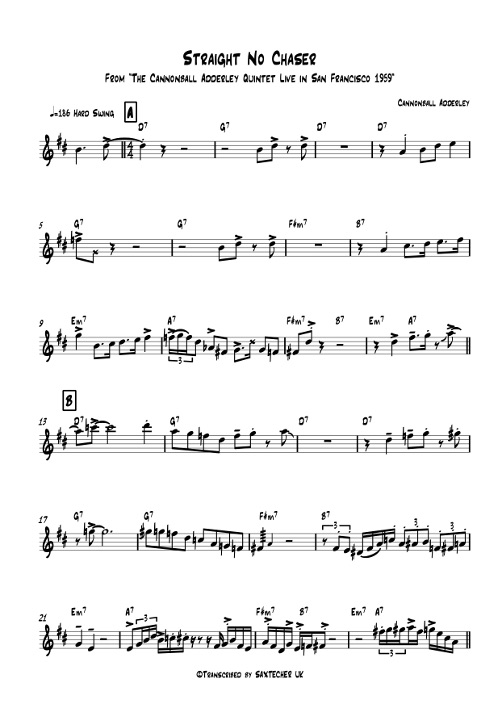
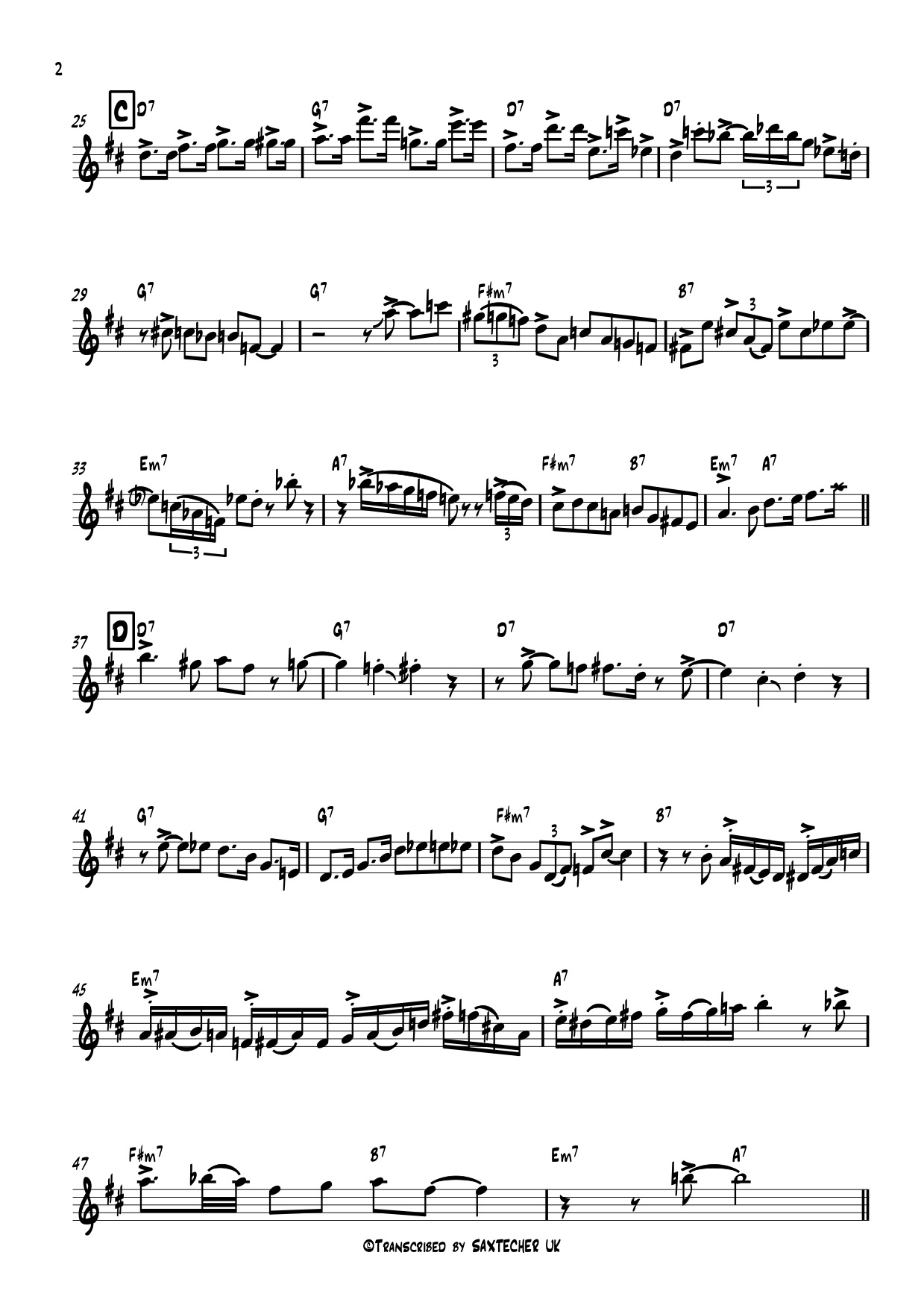
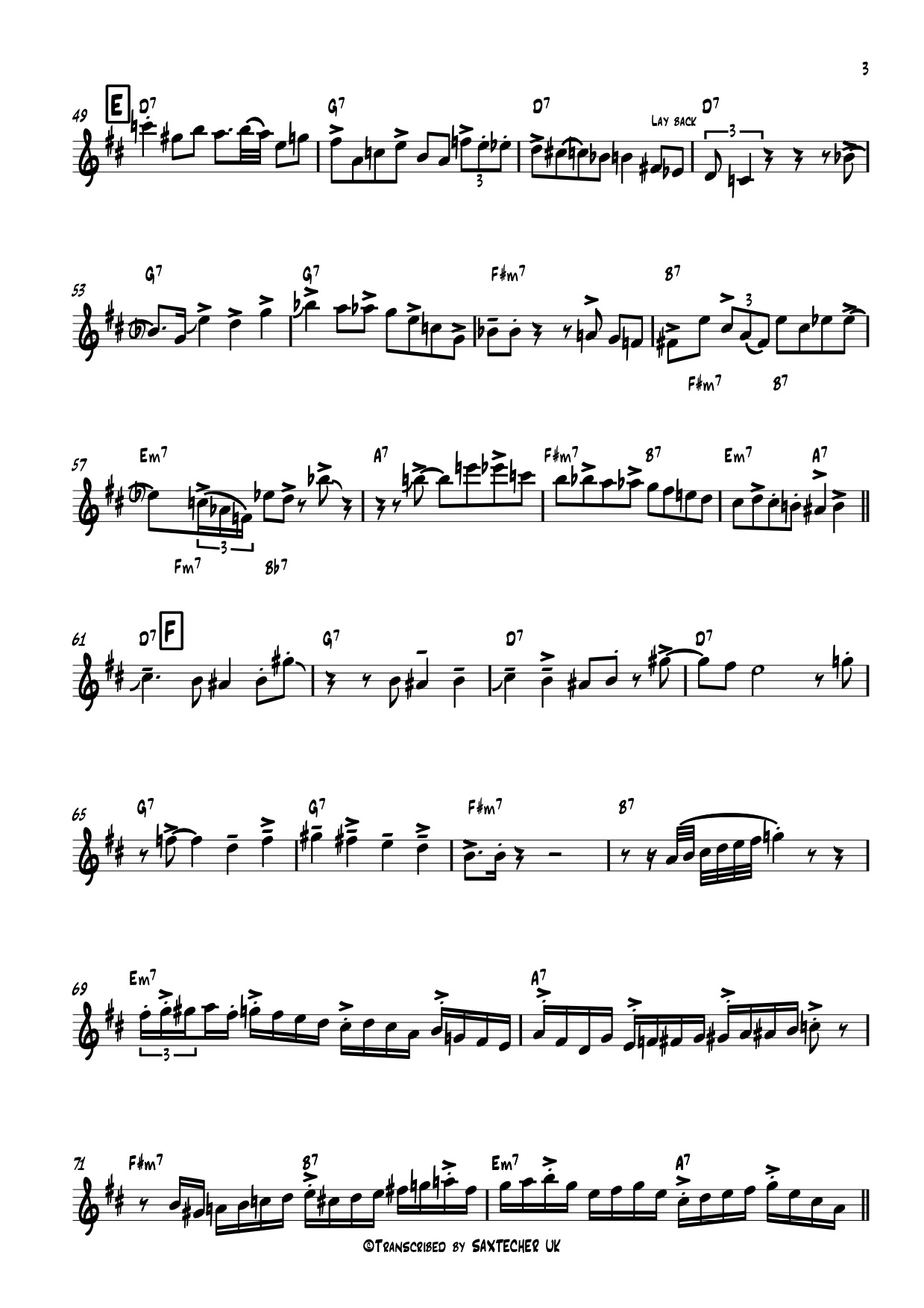
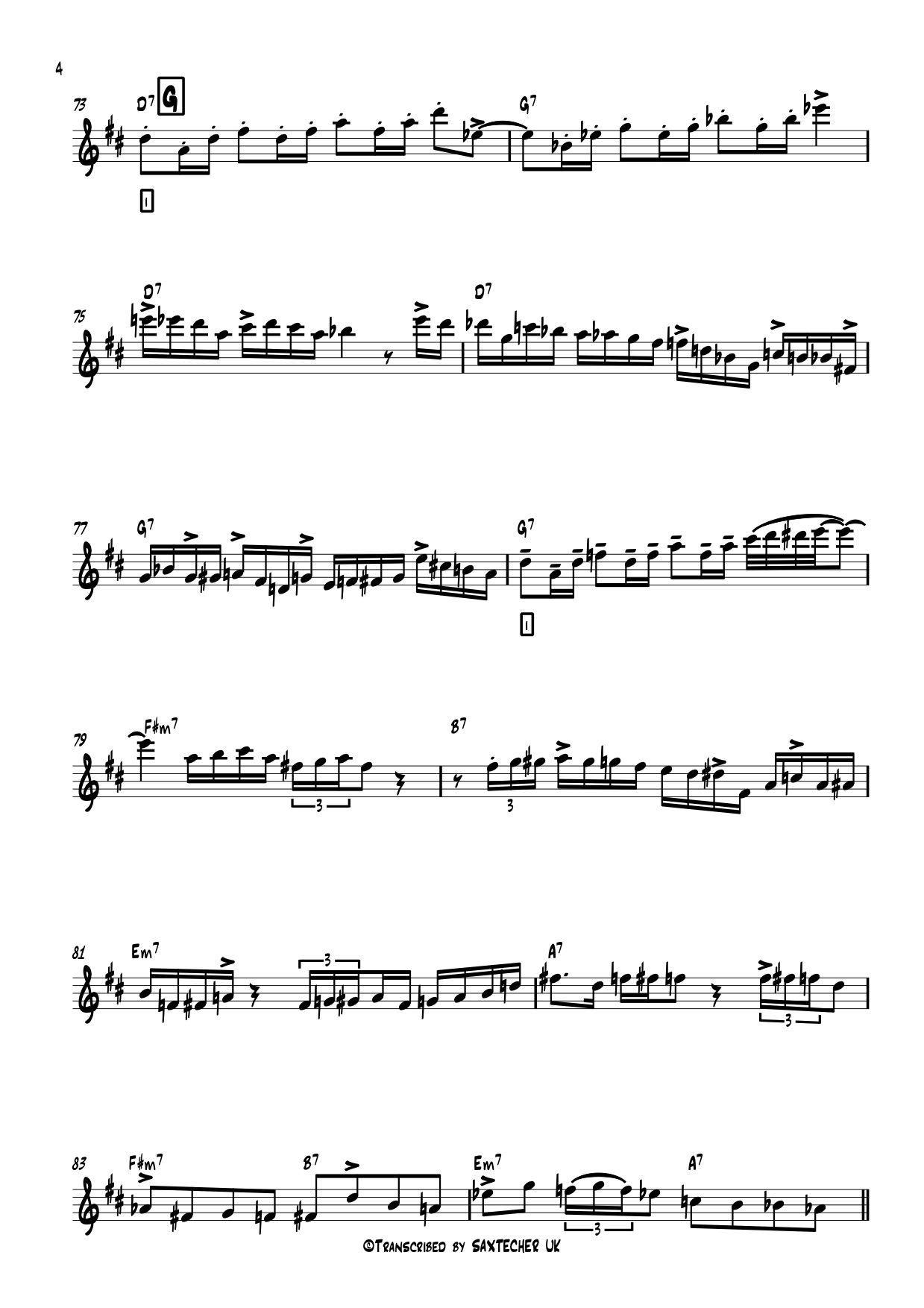
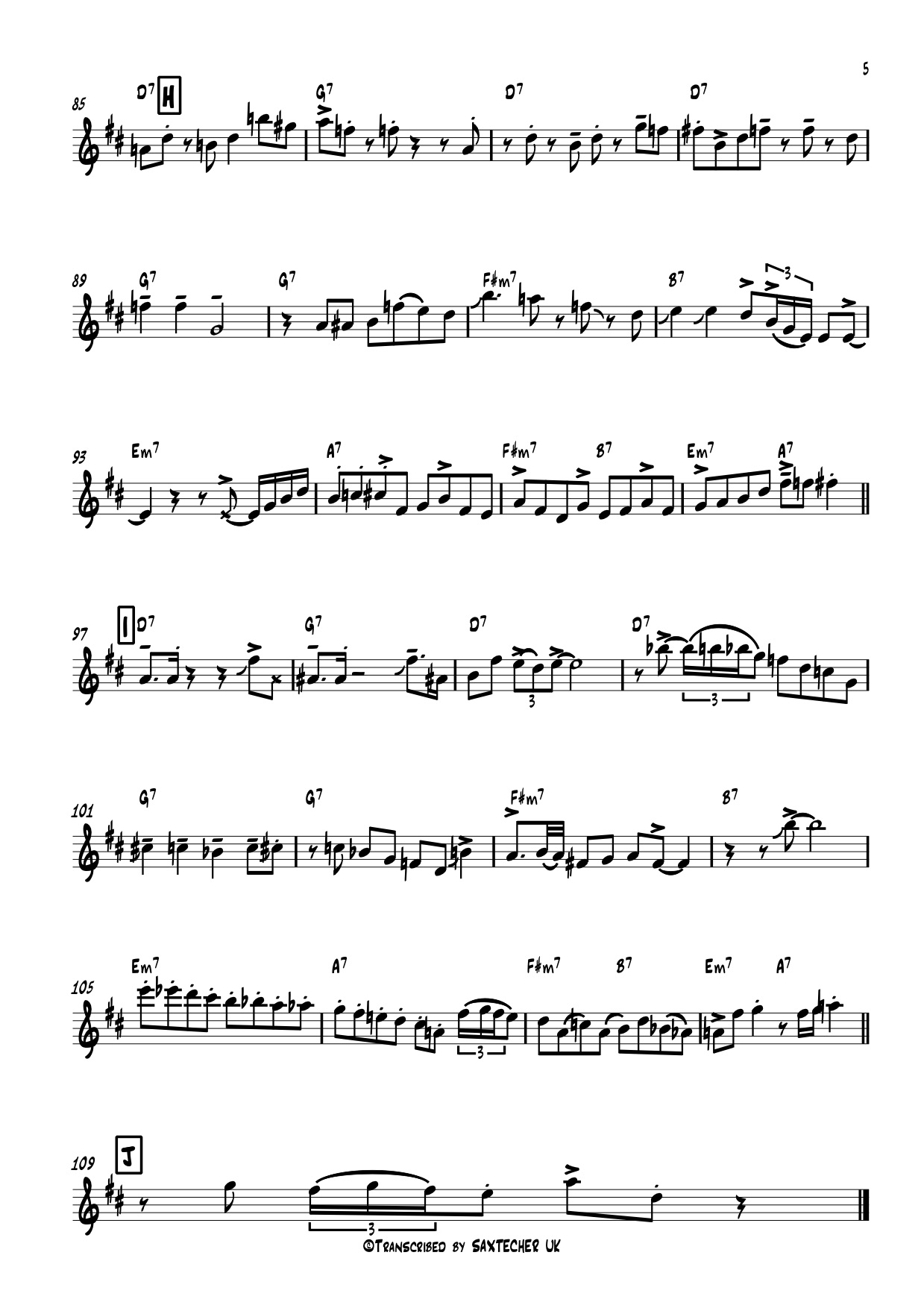
The full transcription is shown below. Study the score alongside the recording — focus on absorbing Cannonball's articulation and rhythmic feel, not just the pitches. Free PDF downloads are available beneath the score.

Page 1 of 5 Straight No Chaser saxophone transcription — Cannonball Adderley alto saxophone solo score, page 1 of 5
Page 2 of 5 Straight No Chaser saxophone transcription — Cannonball Adderley alto saxophone solo score, page 2 of 5
Page 3 of 5 Straight No Chaser saxophone transcription — Cannonball Adderley alto saxophone solo score, page 3 of 5
Page 4 of 5 Straight No Chaser saxophone transcription — Cannonball Adderley alto saxophone solo score, page 4 of 5
Page 5 of 5 Straight No Chaser saxophone transcription — Cannonball Adderley alto saxophone solo score, page 5 of 5

How to Practise This Saxophone Transcription

Advice on Deeper Study

Go for depth, not speed — it doesn't matter how fast you learn it. Learn one chorus in detail at a time. Practise in shorter phrases, gradually making them longer up to a 12-bar chorus. Really listen to and analyse the phrasing and articulation, and try to copy it exactly until you sound exactly like the recording.

Don't worry about tempo. Play it as faithfully as possible with perfect phrasing and articulation at a speed which is comfortable and relaxed. Learn the meaning behind each phrase: what is its history? What does it mean? What is the musical context?

Above all, try to imagine how Cannonball was feeling when he was playing this. Practise this feeling as you practise playing the solo. That's where the real magic of transcription study lies — not in the notes themselves, but in the intention and expression behind them. For more guidance on transcription study, see the practice tips in our Lester Young Shoeshine Boy transcription. If you'd like help working through this solo, consider booking a saxophone lesson — working with a teacher can accelerate your progress enormously.

Free PDF Downloads — Transcription & Lead Sheets

Download the full Cannonball Adderley Straight No Chaser transcription and lead sheets below — all free of charge. The lead sheets are available in Concert pitch, Bb (tenor saxophone) and Eb (alto saxophone). Would you like to see a transcription that isn't on the site? Get in touch and request it!

Frequently Asked Questions

What is Straight No Chaser? +

Straight No Chaser is a 12-bar blues in concert F composed by Thelonious Monk, first recorded in 1951. It is one of the most widely played jazz standards and an essential part of any jazz musician's repertoire. This transcription is taken from the Cannonball Adderley Quintet's legendary live recording at the Jazz Workshop in San Francisco from 1959, and features one of the most exciting and virtuosic alto saxophone solos in jazz history — a masterclass in blues phrasing, articulation and rhythmic variety.

What album is this Straight No Chaser recording from? +

This recording of Straight No Chaser is from the album Cannonball Adderley Quintet in San Francisco, recorded live at the Jazz Workshop in 1959 and released on Riverside Records. The album features Cannonball Adderley on alto saxophone, Nat Adderley on cornet, Bobby Timmons on piano, Sam Jones on bass and Louis Hayes on drums. It is widely regarded as one of the greatest live jazz albums ever recorded.

What is the 12-bar blues form? +

The 12-bar blues is one of the most fundamental chord progressions in jazz, blues, rock and popular music. It follows a repeating 12-bar structure built around the I, IV and V chords of a key, typically with a turnaround at the end. Countless jazz standards are based on this form — including Straight No Chaser, Billie's Bounce, Blue Monk, Bags' Groove and Now's the Time — making it essential learning for any improvising musician.

Is this transcription available for tenor saxophone? +

The transcription is available as a free PDF download in concert pitch. Lead sheets for Straight No Chaser are available in Concert, Bb (tenor saxophone) and Eb (alto saxophone) transpositions. All download links are in the Free PDF Downloads section above.

How should I practise a saxophone transcription? +

Start by listening to the recording many times before touching your saxophone. Then learn the transcription slowly, focusing on matching Cannonball Adderley's articulation and phrasing rather than just the notes. Go for depth, not speed — the goal is to absorb his style and vocabulary, not just learn the dots on the page.

Can I get help learning this solo with saxophone lessons? +

Absolutely. Working through a transcription like this with a teacher can make a huge difference — you'll get direct feedback on your tone, articulation and rhythmic feel, and guidance on how to apply Cannonball Adderley's vocabulary to your own playing. Get in touch to book a saxophone lesson in person or online.

SaxTeacher UK — Founder SaxTeacher UK Founder

SaxTeacher UK is a woodwind and piano teacher based in South East London. With 17 years of individual and group tuition experience. Get in touch for in-person or online lessons.

All author posts

Book a Lesson

Your information will be forwarded to me and I will get back to you as soon as I can.

Sax teacher London

Give me a call

+(44)7704 762 561

We are committed to protecting your privacy. We will never collect information about you.

Scroll