Skip to content
 Play Music, Express Yourself, Be Happy! 

SAX TEACHER UK

Earl Bostic — Hurricane Blues Alto Saxophone Transcription

By SaxTeacher UK on 6 min read
SaxTeacher UK — author photo

Here's another Earl Bostic saxophone transcription for you! This time an early recording from 1945 with the Lionel Hampton Orchestra. Hurricane Blues is a showcase for Earl Bostic's melodic sense and mastery of blues language. Listen to the melodic development he uses — three distinct phrases across this short but sweet 12-bar blues solo, each one a lesson in how to build and repeat an idea with conviction. The full transcription is available as a free PDF download for alto saxophone below.

Triplets and 12/8

Listen to how Earl Bostic plays his lines. He plays phrases in 4/4 but using 8th note triplets throughout — giving the solo a laid-back feel across the beat. His melodic phrases in groups of 2 or 4 played in triplets evoke the feeling of 12/8, the Bembe rhythm rooted in West African music that is foundational to American jazz and Cuban music.

Repeat Your Ideas

Earl Bostic plays very strong blues phrases — rooted in vocalists and traceable back through African-American church music and work songs. His lines are so good he repeats them, developing and embellishing each idea the second or third time around. Practise playing a phrase and repeating it with variation over a full 12-bar chorus.

Newsletter

Get Free Sheet Music & Tips

Tips, tutorials & new posts delivered to your inbox. No spam, unsubscribe any time.

We are committed to protecting your privacy. We will never collect information about you.

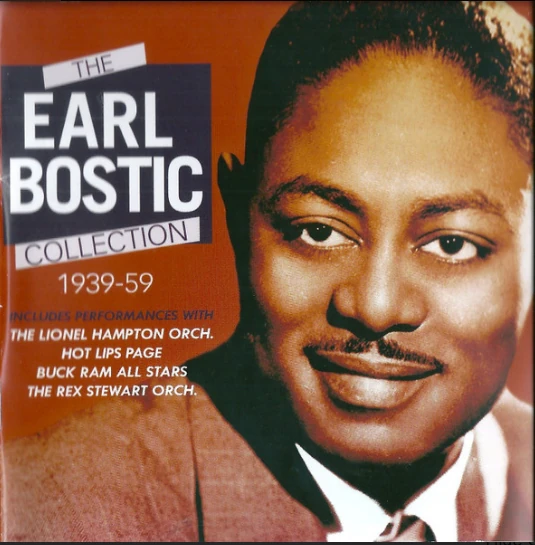
Earl Bostic — Alto Saxophonist Biography

The Alto Saxophone Powerhouse

Earl Bostic was born in Tulsa, Oklahoma on 25 April 1913, and went on to become one of the most technically accomplished alto saxophonists in jazz history. He studied music formally at Xavier University in New Orleans before moving to New York in the late 1930s, where he established himself as both a sideman and an arranger of rare ability.

Bostic's tone was extraordinary — full, penetrating and absolutely unmistakable. He had a command of the altissimo register that was decades ahead of most of his contemporaries, and a bluesy intensity rooted in gospel and the deep south that gave everything he played an irresistible directness. He could swing hard, play ballads of devastating tenderness, and produce R&B hits that filled dance halls across America.

His influence extended far beyond his own recordings. John Coltrane worked in Bostic's band in the early 1950s and later credited him as a major influence on his understanding of saxophone technique. Benny Golson, Stanley Turrentine and many others passed through his orbit. Earl Bostic died in Rochester, New York on 28 October 1965 — a giant of the saxophone whose contributions to the music remain deeply underappreciated.

The Lionel Hampton Orchestra — Hurricane Blues, 1945

Decca Records

By 1945 Earl Bostic was an in-demand musician across the New York scene, working as a sideman and arranger while leading his own small groups. His appearance with the Lionel Hampton Orchestra places him within one of the most exciting big bands of the era — a group known for its ferocious energy, hard-swinging rhythm section and a roster of soloists who were never less than committed.

Hampton's band was a proving ground. The style demanded musicians who could project over a full orchestra, hold their own in a solo spotlight, and deliver blues feeling with conviction. Bostic did all three. His contribution to Hurricane Blues is brief but absolutely characteristic — every phrase counts, every note placed with purpose.

The recording captures a moment in jazz history when the blues and big-band swing were still deeply intertwined, before bebop fully transformed the landscape. Bostic's solo stands as a perfect example of how much could be communicated in just 12 bars when a player knew exactly what they were doing.

Hurricane Blues

The Tune and the Solo

Hurricane Blues is a straightforward 12-bar blues — the fundamental form of American music, and one that rewards a lifetime of study. What makes Bostic's solo remarkable is not harmonic complexity but melodic intelligence. He works from the blues scale with complete authority, building three distinct phrases that feel inevitable even on first hearing.

The triplet feel is central to everything here. By phrasing his lines in triplets against a 4/4 pulse, Bostic creates a rhythmic tension and lilt that is the essence of blues feeling. This is the 12/8 sensibility embedded in the music — the Bembe feel that connects jazz and blues to its deepest African-American roots. It is a device that sounds simple but takes real commitment and physical ease to execute convincingly.

The repetition and development of his ideas is equally instructive. Bostic does not move on to a new idea simply for variety — he returns to each phrase, reshapes it, and lets it breathe. This is the vocabulary of the blues preacher and the gospel singer translated directly onto the saxophone, and it is one of the most powerful compositional tools available to any improviser.

Earl Bostic — Hurricane Blues, Lionel Hampton Orchestra, 1945 recording

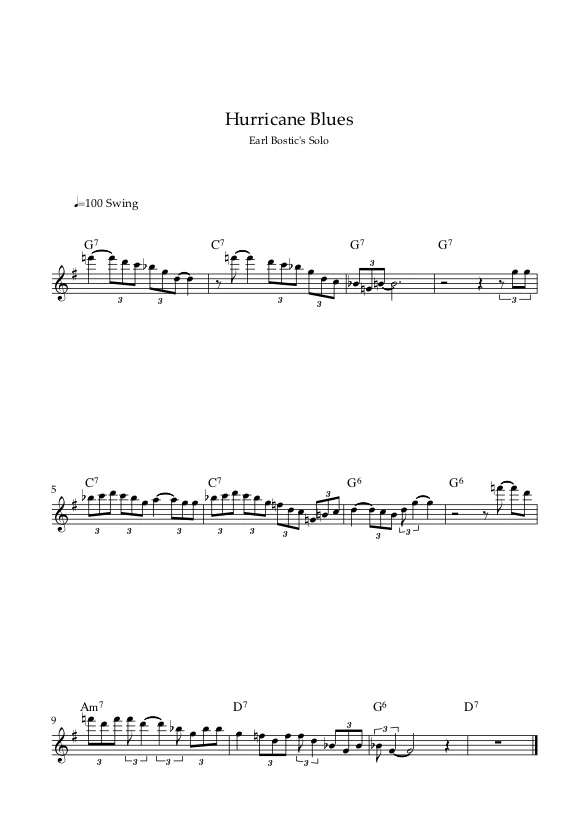
Hurricane Blues — Earl Bostic Alto Saxophone Transcription

Full Score — Earl Bostic Alto Saxophone Solo

The full transcription is shown below. Study the score alongside the recording — focus on absorbing Bostic's articulation and rhythmic feel, not just the pitches. A free PDF download transposed for alto saxophone is available beneath the score.

Earl Bostic Hurricane Blues alto saxophone transcription score — free PDF sheet music

Free PDF Downloads

All transcriptions are available free of charge. Would you like to see a transcription that isn't on the site? Get in touch and request it!

Frequently Asked Questions

Who is Earl Bostic? +

Earl Bostic (1913–1965) was an American alto saxophonist whose extraordinary technical command and raw, blues-drenched sound made him one of the most influential saxophonists of the 1940s and 50s. He played with Lionel Hampton, led his own enormously popular R&B groups, and taught or influenced players including John Coltrane, Benny Golson and Stanley Turrentine.

What is Hurricane Blues? +

Hurricane Blues is a 12-bar blues recorded by the Lionel Hampton Orchestra in 1945. Bostic's solo is a masterclass in melodic development, blues vocabulary and rhythmic feel — playing short, repeating phrases in triplets that give the line a laid-back, 12/8 quality rooted in the deepest African-American musical traditions.

What saxophone is the transcription written for? +

The Hurricane Blues transcription is available as a free PDF transposed for alto saxophone (Eb). The download link is in the Free PDF Downloads section above.

How should I practise a saxophone transcription? +

Start by listening to the recording many times before touching your saxophone. Then learn the transcription slowly, focusing on matching Earl Bostic's articulation and phrasing rather than just the notes. Repetition is key — the goal is to absorb his style and vocabulary, not just learn the dots on the page.

Can I get help learning this solo with saxophone lessons? +

Absolutely. Working through a transcription like this with a teacher can make a huge difference — you'll get direct feedback on your tone, articulation and rhythmic feel, and guidance on how to apply Bostic's vocabulary to your own playing. Get in touch to book a saxophone lesson in person or online.

SaxTeacher UK — Founder SaxTeacher UK Founder

SaxTeacher UK is a woodwind and piano teacher based in South East London. With 17 years of individual and group tuition experience. Get in touch for in-person or online lessons.

All author posts

Book a Lesson

Your information will be forwarded to me and I will get back to you as soon as I can.

Sax teacher London

Give me a call

+(44)7704 762 561

We are committed to protecting your privacy. We will never collect information about you.

Scroll