Skip to content
 Play Music, Express Yourself, Be Happy! 

SAX TEACHER UK

Basin St Blues — Johnny Hodges Transcription

By SaxTeacher UK on 7 min read
SaxTeacher UK — author photo

Johnny Hodges was one of the great lyrical voices in jazz — a musician whose tone, phrasing and sense of swing were incomparable. This article explores his life and playing, the celebrated Back to Back album recorded with Duke Ellington, and the solo on Basin St Blues itself: a rare and illuminating example of a saxophonist comping behind another soloist. The full transcription is available as a free PDF download for alto saxophone.

Listen to the Interplay

This transcription is about conversation, not solo virtuosity. Before you pick up your saxophone, listen carefully to how Hodges and Harry Edison interact — notice where Hodges plays, but pay equal attention to where he stays silent and gives space.

Study Rhythm, Not Just Melody

The real lesson here is rhythmic placement. Hodges' backing lines are deceptively simple — their power comes from when he plays them. Focus on the push-pull relationship between the counter-melody and the soloist's phrasing.

Newsletter

New Solo Transcriptions

Get a short email whenever a new solo transcription goes up. No spam, unsubscribe any time.

We’ll only email you new transcriptions and tutorials, and you can unsubscribe any time. See our Privacy Policy.

Need a solo or song that isn’t here? I can transcribe it for you — piano, sax & jazz solos, lead sheets or horn sections & big band, in Concert, B♭ and E♭.

About Johnny Hodges

The Voice of the Ellington Orchestra

Johnny Hodges (1907–1970) spent more than forty years as lead alto saxophonist of the Duke Ellington Orchestra, shaping a sound so personal that Ellington wrote dozens of pieces around it. This page focuses on his playing on Basin Street Blues; for his complete biography, recordings and influence, see the full Johnny Hodges profile, or build the same vocabulary with guidance in saxophone lessons.

Back to Back

Duke Ellington & Johnny Hodges — Verve Records, 1959

Back to Back was recorded in 1959 for Verve Records and features Duke Ellington and Johnny Hodges in an informal, small-group blues setting. Alongside them are Harry 'Sweets' Edison on trumpet, Ben Webster on tenor saxophone, Les Spann on guitar, Jimmy Woode on bass and Sam Woodyard on drums. The album has an intimate, after-hours feel — a deliberate contrast to the large-orchestra recordings for which Ellington was best known.

The concept was to strip everything back to the blues: no elaborate arrangements, no orchestra, just a small group of master musicians playing with total freedom. The result is one of the most relaxed and genuinely swinging records in the Ellington catalogue. Basin St Blues, the standard that opens the album, captures the spirit perfectly — a slow, glowing blues in which every musician plays with a feeling of deep contentment.

What makes the recording particularly unusual — and particularly instructive for saxophone students — is the role Hodges takes on Basin St Blues. Rather than soloing, he backs Harry 'Sweets' Edison's trumpet solo with a composed counter-melody of his own. It is a rare chance to study how one of the great saxophonists of the swing era approached the art of accompaniment.

Johnny Hodges — Back to Back album, Duke Ellington, Verve Records 1959 Find the album

Basin St Blues

The Tune and the Backing Solo

Basin Street Blues is a classic New Orleans jazz standard, composed by Spencer Williams and first recorded in the 1920s. By the time Hodges and Ellington recorded it in 1959, it was well-established territory — a vehicle for blues feeling and relaxed swing rather than harmonic complexity. The slow tempo and familiar form give the musicians room to breathe.

As a single-line instrument, saxophone players rarely get the opportunity — or the encouragement — to experience 'comping.' This transcription is all about backings. Johnny Hodges improvises a counter-melody to Harry 'Sweets' Edison's killer solo, and the result is a masterclass in the art of restraint, space and mutual listening.

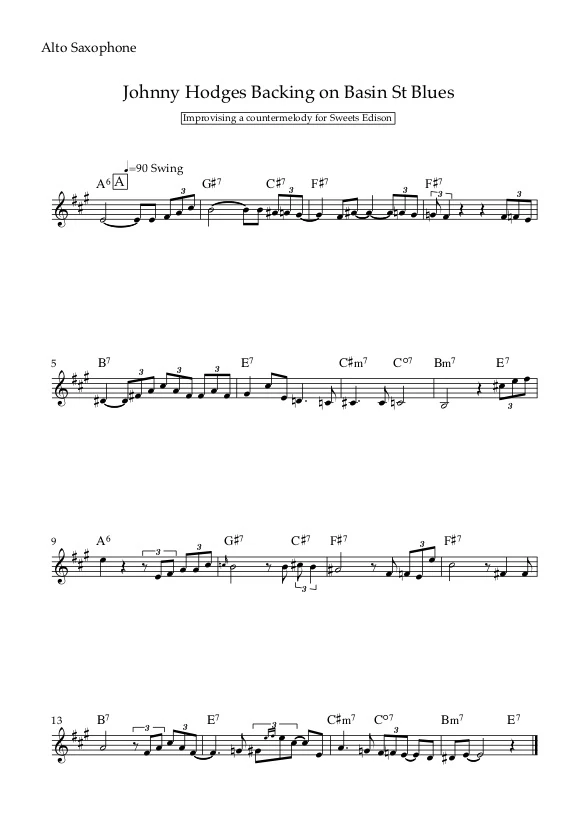
The biggest challenge when backing another single-line instrument is keeping out of the way. Hodges sticks to a similar repeated rhythmic pattern throughout, centring around resolution on beat one. This gives Edison plenty of space to improvise his creative melodic line. The slow tempo demands the use of eighth-note triplets to maintain rhythmic momentum in the counter-line — listen to the push-pull relationship between trumpet and saxophone creating dynamic interest in the overall texture. Many players might play half-note guide tones when backing, but Hodges' effective use of rhythm maintains consistency with a subtle but compelling effect.

The Transcription — Basin St Blues

Full Score — Johnny Hodges Alto Saxophone Backing

The full transcription is shown below. Study the score alongside the recording — focus on absorbing Hodges' rhythmic placement and phrasing, not just the pitches. Listen carefully to where he plays and where he leaves space. The free PDF download for alto saxophone is available beneath the score.

Basin St Blues saxophone transcription — Johnny Hodges alto saxophone backing score

Comping and Backing on Saxophone

A Guide for Saxophonists

Comping is a skill that saxophone players rarely practise — yet it is one that transforms ensemble playing. Johnny Hodges demonstrates two key principles on Basin St Blues: harmonic clarity through guide tones, and rhythmic restraint through careful placement.

On the harmonic side, Hodges makes clear use of a fixed guide tone progression to highlight the cycle of fourths in the harmony. This creates a sense of predictability and reliability for the main soloist, with subtle variations that keep the accompaniment fresh and engaged without drawing attention away from Edison's solo. Many saxophone players when accompanying will play an immaculate series of guide tones — but Hodges shows creativity and courage with delayed resolutions, combining rhythmic and harmonic elements to create an accompaniment that propels the soloist forward without getting in the way.

The slow tempo of Basin St Blues makes this a wonderful piece to study before attempting to apply these ideas at faster tempos. Focus on choosing your moments: when to play, when to rest, and how to respond to what the soloist is doing.

Free PDF Downloads

All transcriptions and guides are available free of charge. Would you like to see a transcription that isn't on the site? Get in touch and request it!

Frequently Asked Questions

What is Basin St Blues about? +

Basin St Blues is a classic New Orleans jazz standard, here recorded on the album Back to Back (Verve Records, 1959) by Duke Ellington and Johnny Hodges. In this version, Johnny Hodges improvises a counter-melody behind Harry 'Sweets' Edison's trumpet solo — a masterclass in the art of comping and backing for a single-line instrument.

What does 'comping' mean on saxophone? +

Comping (short for accompanying) is the art of playing supportive lines behind another soloist. While pianists and guitarists comp rhythmically and harmonically using chords, saxophone players — as single-line instruments — comp by playing counter-melodies, guide tones and rhythmic figures that complement the soloist without getting in the way. Basin St Blues is a superb example of how a saxophonist can comp effectively.

Is the Basin St Blues transcription available for alto saxophone? +

Yes — the Basin St Blues transcription is available as a free PDF transposed for Eb (alto saxophone). The download link is in the Free PDF Downloads section above.

How should I practise a saxophone transcription? +

Start by listening to the recording many times before touching your saxophone. Then learn the transcription slowly, focusing on matching Johnny Hodges' articulation and phrasing rather than just the notes. In a backing transcription like this one, pay particular attention to the rhythmic placement — understanding where Hodges plays and, crucially, where he leaves space.

Can I get help learning this solo with saxophone lessons? +

Absolutely. Working through a transcription like this with a teacher can make a huge difference — you'll get direct feedback on your tone, articulation and rhythmic feel, and guidance on how to apply Hodges' vocabulary to your own playing. Get in touch to book a saxophone lesson in person or online.

SaxTeacher UK — Founder SaxTeacher UK Founder

SaxTeacher UK is a woodwind and piano teacher based in South East London. With 17 years of individual and group tuition experience. Get in touch for in-person or online lessons.

All author posts

Book a Lesson

Your information will be forwarded to me and I will get back to you as soon as I can.

Sax teacher London

Give me a call

+(44)7704 762 561

We use your details only to reply to your enquiry and arrange lessons. We never sell or share them. See our Privacy Policy.

Scroll