Skip to content
 Play Music, Express Yourself, Be Happy! 

SAX TEACHER UK

Oh, Lady Be Good! — Lester Young Transcription

By SaxTeacher UK on 8 min read
SaxTeacher UK — author photo

Oh, Lady Be Good! is one of the most important and influential solos in the history of jazz saxophone. Lester goes hard from his pickup beat right through to his final note. It's a showcase for his incredible sound, varied articulation and phrasing, and melodic compositional development. Many of the harmonic and rhythmic techniques he used in this solo set the standard for his generation, becoming a launchpad for the bebop music of the 1940s. This article explores Lester Young's life and playing, the history of the tune, and a detailed look at the solo's rhythmic and melodic language. The full transcription is available as free sheet music for both tenor and alto saxophone.

Study the Man, Not Just the Notes

Lester Young revolutionised the tenor saxophone. Read about his background and musical language before diving into the transcription — understanding who he was makes the music make more sense.

Listen, Then Transcribe

Remember that transcribing an improvised solo is primarily an aural activity, not an exercise in reading. Always try to do as much as possible from the recording itself, and only use this transcription if you are really stuck on a phrase.

Newsletter

Get Free Sheet Music & Tips

Tips, tutorials & new posts delivered to your inbox. No spam, unsubscribe any time.

We are committed to protecting your privacy. We will never collect information about you.

Lester Young — Biography

The President of the Tenor Saxophone

Lester Willis Young was born in Woodville, Mississippi on 27 August 1909 and grew up in a musical family — his father taught all of his children to play multiple instruments. Young initially played drums and alto saxophone before settling on the tenor, and by the mid-1930s he had developed a style that was utterly unlike anything else in jazz. Where Coleman Hawkins — the dominant tenor voice of the era — played with a heavy, rhapsodic vibrato and densely harmonic approach, Young offered something lighter, cooler and more lyrical: a sound that floated above the rhythm section with effortless grace.

His time with the Count Basie Orchestra, beginning in 1936, cemented his reputation. Young's playing on the early Basie small-group recordings — including Shoeshine Boy and Oh, Lady Be Good! — announced a new way of playing the tenor saxophone. His tone was airy and relaxed, his phrasing vocal and behind the beat, and his melodic choices startlingly original. He had a gift for creating long, flowing lines that sounded inevitable, as though there were no other notes he could possibly have played.

Billie Holiday nicknamed him 'Pres' — short for President — and the name stuck. His influence on the generation of musicians who followed, from Charlie Parker to Stan Getz, was immense. Despite personal struggles in later life, including a devastating period of military service during World War II, Young's recorded legacy remains one of the most beautiful and influential in all of jazz.

About the Solo — Oh, Lady Be Good!

The Tune and the Solo

Oh, Lady Be Good! is a jazz standard composed by George Gershwin with lyrics by Ira Gershwin, originally written for the 1924 musical 'Lady, Be Good!' The tune became a favourite vehicle for jazz musicians throughout the swing era and beyond. Lester Young's 1936 recording of the tune is widely regarded as one of the most important tenor saxophone solos in the history of jazz — a landmark performance that laid the groundwork for a new approach to improvisation.

Young's solo on Oh, Lady Be Good! is built on a straightforward 32-bar AABA song form, but what he does with it is anything but straightforward. Rather than relying on elaborate harmonic substitutions, he works primarily from melody and rhythm, finding freshness through the clarity and conviction of his ideas. His phrasing is vocal and conversational, his melodic development logical and compelling, and his rhythmic placement utterly assured. It's a masterclass in how to say something profound with simple materials. For a comparison of how Lester approached a different form from the same period, see our transcription of Lester Young's solo on Shoeshine Boy — a rhythm changes masterpiece from the same 1936 session.

Time, Rhythms and Articulation in Lester Young's Solo

What Makes This Solo Special

Lester's time in this solo is remarkably driving and confident. From the very first pickup beat, he establishes a forward momentum that never lets up. His articulation is varied and precise — a mix of legato phrases, punchy staccato notes and ghosted tones that give the solo a vocal, speech-like quality. Pay close attention to how he shapes each phrase: the way he accents certain notes, the way he uses silence, and the way he builds and releases tension across the form.

One of the most striking features of this solo is the melodic compositional development. Lester doesn't just string together licks — he develops motifs, returning to ideas and varying them in ways that give the solo a sense of narrative arc. Many of the harmonic and rhythmic techniques he used here became standard vocabulary for the next generation of jazz musicians, making this solo essential study for any aspiring jazz saxophonist.

The Transcription — Oh, Lady Be Good!

Full Score — Lester Young Tenor Saxophone Solo

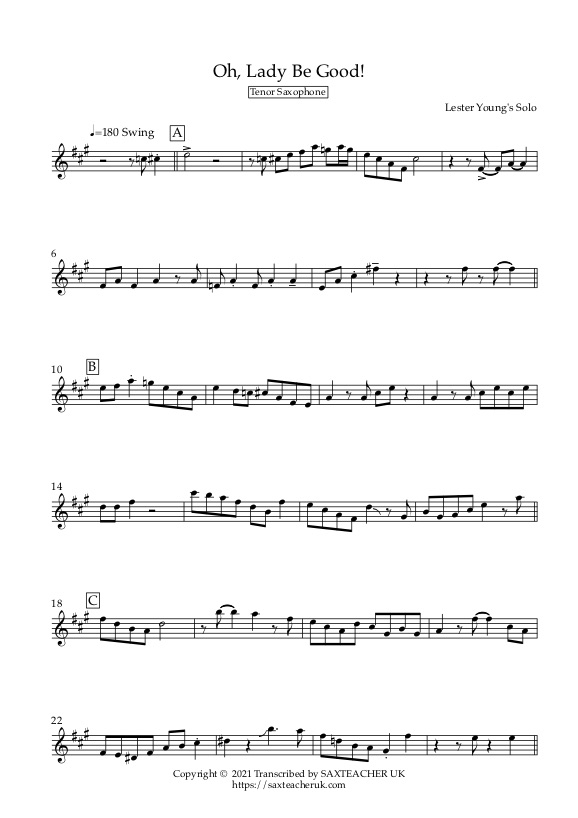
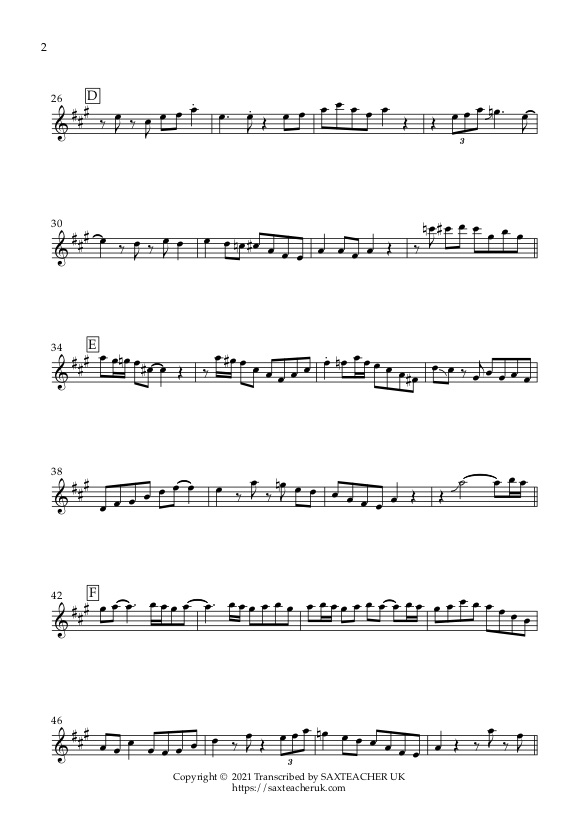
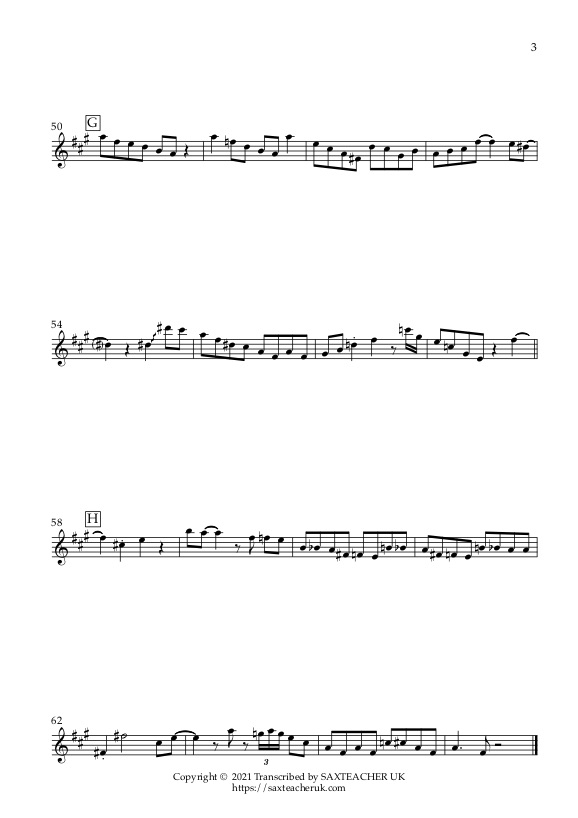
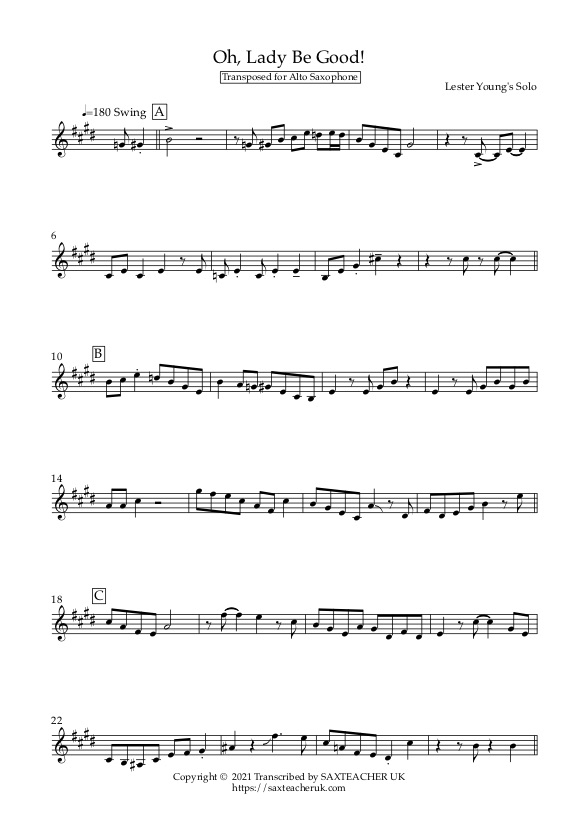
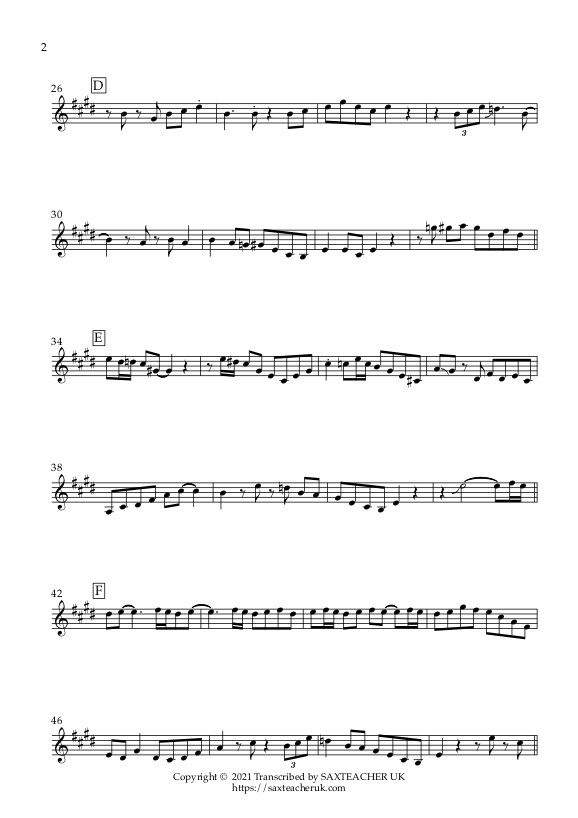
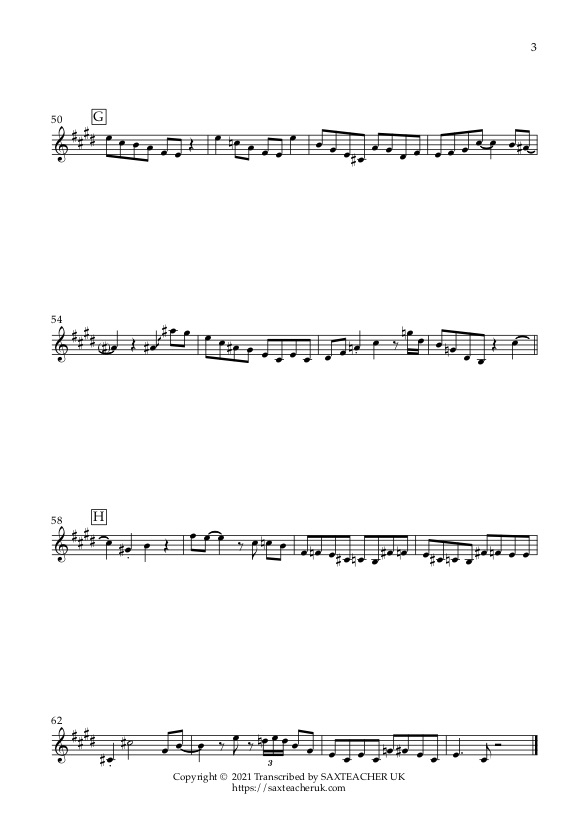
The full transcription is shown below. Study the score alongside the recording — focus on absorbing Lester's articulation and rhythmic feel, not just the pitches. Free PDF downloads for both tenor and alto saxophone are available beneath the score.

Page 1 of 2 Lester Young Oh Lady Be Good transcription — free tenor saxophone sheet music, page 1 of 2
Page 2 of 2 Lester Young Oh Lady Be Good transcription — free tenor saxophone sheet music, page 2 of 2

How to Practise This Saxophone Transcription

Advice on Deeper Study

Go for depth, not speed — it doesn't matter how fast you learn it. Practise in shorter phrases, gradually making them longer. Really listen to and analyse the phrasing and articulation, and try to copy it exactly until you sound exactly like the recording.

Don't worry about tempo. Play it as faithfully as possible with perfect phrasing and articulation at a speed which is comfortable and relaxed. Learn the meaning behind each phrase: what is its history? What does it mean? What is the musical context?

Above all, try to imagine how Lester was feeling when he was playing this. Practise this feeling as you practise playing the solo. That's where the real magic of transcription study lies — not in the notes themselves, but in the intention and expression behind them. If you'd like help working through this solo, consider booking a saxophone lesson — working with a teacher can accelerate your progress enormously.

Free PDF Downloads

All transcriptions and guides are available free of charge. Would you like to see a transcription that isn't on the site? Get in touch and request it!

Frequently Asked Questions

What is Oh, Lady Be Good? +

Oh, Lady Be Good! is a jazz standard composed by George Gershwin with lyrics by Ira Gershwin, originally written for the 1924 musical 'Lady, Be Good!' Lester Young's 1936 recording of this tune is widely regarded as one of the most important and influential tenor saxophone solos in the history of jazz, showcasing his incredible sound, varied articulation and melodic compositional development.

Why is Lester Young's solo on Oh, Lady Be Good! so important? +

Lester Young's solo on Oh, Lady Be Good! is considered a landmark recording because many of the harmonic and rhythmic techniques he used set the standard for his generation and became a launchpad for the bebop music of the 1940s. His melodic approach, varied articulation and compositional development in this solo influenced countless musicians who followed.

Is this transcription available for alto saxophone? +

Yes — the Oh, Lady Be Good! transcription is available as a free PDF in both Bb (tenor saxophone) and Eb (alto saxophone) transpositions. Both download links are in the Free PDF Downloads section above.

How should I practise a saxophone transcription? +

Start by listening to the recording many times before touching your saxophone. Then learn the transcription slowly, focusing on matching Lester Young's articulation and phrasing rather than just the notes. Go for depth, not speed — the goal is to absorb his style and vocabulary, not just learn the dots on the page.

Can I get help learning this solo with saxophone lessons? +

Absolutely. Working through a transcription like this with a teacher can make a huge difference — you'll get direct feedback on your tone, articulation and rhythmic feel, and guidance on how to apply Lester Young's vocabulary to your own playing. Get in touch to book a saxophone lesson in person or online.

SaxTeacher UK — Founder SaxTeacher UK Founder

SaxTeacher UK is a woodwind and piano teacher based in South East London. With 17 years of individual and group tuition experience. Get in touch for in-person or online lessons.

All author posts

Book a Lesson

Your information will be forwarded to me and I will get back to you as soon as I can.

Sax teacher London

Give me a call

+(44)7704 762 561

We are committed to protecting your privacy. We will never collect information about you.

Scroll