Skip to content
 Play Music, Express Yourself, Be Happy! 

SAX TEACHER UK

Way Down Yonder in New Orleans — Lester Young Transcription

By SaxTeacher UK on 8 min read
SaxTeacher UK — author photo

Way Down Yonder in New Orleans is one of Lester Young's most beautiful recorded tenor saxophone solos — a masterclass in melodic development and jazz phrasing that says everything it needs to say with grace and economy. Recorded in 1938 with the Count Basie Orchestra, this jazz standard showcases Lester's warm, honeyed tone floating effortlessly over the rhythm section, with subtle ghost notes, half-tonguing and glissandos adding elegance to every phrase. This article explores Lester Young's life and playing, the history of the tune, a detailed look at the solo's sound and phrasing — including a guide to saxophone glissando technique — and advice on deeper study. The full transcription is available as free sheet music for both tenor and alto saxophone.

Study the Man, Not Just the Notes

Lester Young revolutionised the tenor saxophone. Read about his background and musical language before diving into the transcription — understanding who he was makes the music make more sense.

Listen, Then Transcribe

Remember that transcribing an improvised solo is primarily an aural activity, not an exercise in reading. Always try to do as much as possible from the recording itself, and only use this transcription if you are really stuck on a phrase.

Newsletter

Get Free Sheet Music & Tips

Tips, tutorials & new posts delivered to your inbox. No spam, unsubscribe any time.

We are committed to protecting your privacy. We will never collect information about you.

Lester Young — A Biography

The President of the Tenor Saxophone

Lester Willis Young was born in Woodville, Mississippi on 27 August 1909 and grew up in a musical family — his father, Willis Handy Young, taught all of his children to play multiple instruments. Young initially played drums and alto saxophone before settling on the tenor, and by the mid-1930s he had developed a style that was utterly unlike anything else in jazz. Where Coleman Hawkins — the dominant tenor voice of the era — played with a heavy, rhapsodic vibrato and densely harmonic approach, Young offered something lighter, cooler and more lyrical: a sound that floated above the rhythm section with effortless grace.

His time with the Count Basie Orchestra, beginning in 1936, cemented his reputation. Young's playing on the early Basie small-group and big-band recordings — including Way Down Yonder in New Orleans — announced a new way of playing the tenor saxophone. His tone was airy and relaxed, his phrasing vocal and behind the beat, and his melodic choices startlingly original. He had a gift for creating long, flowing lines that sounded inevitable, as though there were no other notes he could possibly have played.

Billie Holiday nicknamed him 'Pres' — short for President — and the name stuck. His influence on the generation of musicians who followed, from Charlie Parker to Stan Getz and the entire cool jazz movement of the 1950s, was immense. Despite personal struggles in later life, including a devastating period of military service during World War II, Young's recorded legacy remains one of the most beautiful and influential in all of jazz. For a deeper study of his playing, explore our transcription of Lester Young's solo on Shoeshine Boy.

Way Down Yonder in New Orleans — The Tune and Lester Young's Solo

History of the Jazz Standard

Way Down Yonder in New Orleans was written by lyricist Henry Creamer and composer Turner Layton in 1922. The song became a jazz standard almost immediately, recorded by artists from Louis Armstrong and Freddy Keppard to later swing-era big bands. Its warm, lyrical melody and relaxed harmonic structure make it an ideal vehicle for improvisation — and Lester Young's 1938 recording with the Count Basie Orchestra stands as one of the definitive versions.

Lester's solo captures everything that made him special — beautiful melodic development delivered with a light, singing tone and an unerring sense of swing. Where many soloists of the era relied on fast runs and harmonic complexity, Lester takes the opposite approach. His lines are spacious and song-like, each phrase growing naturally from the one before. The solo is a perfect example of his gift for melodic invention — saying everything that needs to be said with clarity and elegance, never a note wasted.

For more examples of Lester's playing, see our transcription of Shoeshine Boy — another essential Lester Young solo built on rhythm changes. You can also compare his approach with Sonny Rollins' solo on Newk's Fadeaway to hear how the next generation of tenor saxophonists built on Lester's legacy.

Saxophone Sound, Phrasing and Glissando Technique

What Makes This Tenor Saxophone Solo Special

Lester's sound echoes along the years. With just a recording the listener is left to imagine what it was really like to hear him play for real. Even on this relatively good reproduction for the time, you can hear that honeyed warmth in his tone, the consistency across the whole range of the instrument. Whether you're playing alto or tenor saxophone, try to copy his sound exactly — match the timbre of his instrument with yours, no matter what the setup you are playing on. This will take a long time, so get going!

There is lots of really subtle phrasing in this solo — subtleties of ghost notes, half-tonguing and glissandos. All of these finishing touches add elegance and shape to the beautiful melodies he improvises and they are a key part of the solo. Listen in detail and try to figure out your own techniques of shading with the tongue, diaphragm and a combination of both. For more on developing your jazz phrasing, see our tutorial hub.

With the glissandos, I recommend you learn the solo first before adding them in, so you get a strong sense of the melodic and rhythmic core of the melody. These glissandos are almost entirely using the finger technique — start on the note below the target note and gradually lift your finger (or press down the key). You'll notice a 'biting point' in the mechanism where the gliss takes effect. Practise this away from the solo for a while first. Although Lester does use some embouchure adjustments to shape some of the glissandos, I recommend you practise them using only your fingers until they are really comfortable. This will avoid reinforcing the 'lip-drop' habit to simulate the gliss, which is not the correct technique.

The Transcription — Way Down Yonder in New Orleans

Full Score — Lester Young Tenor Saxophone Solo

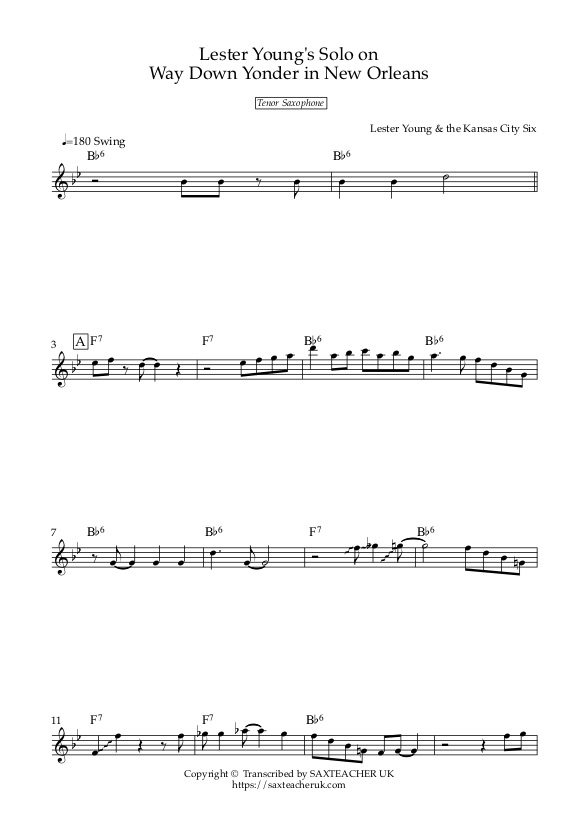
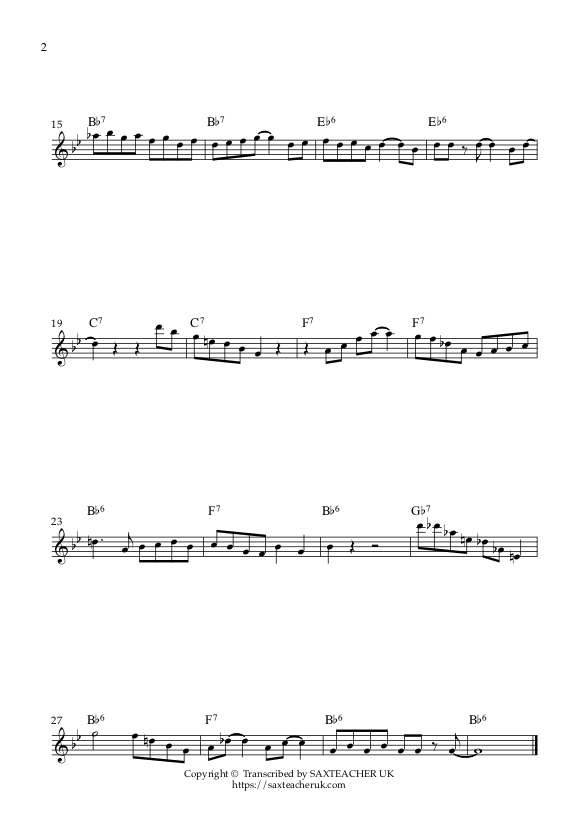
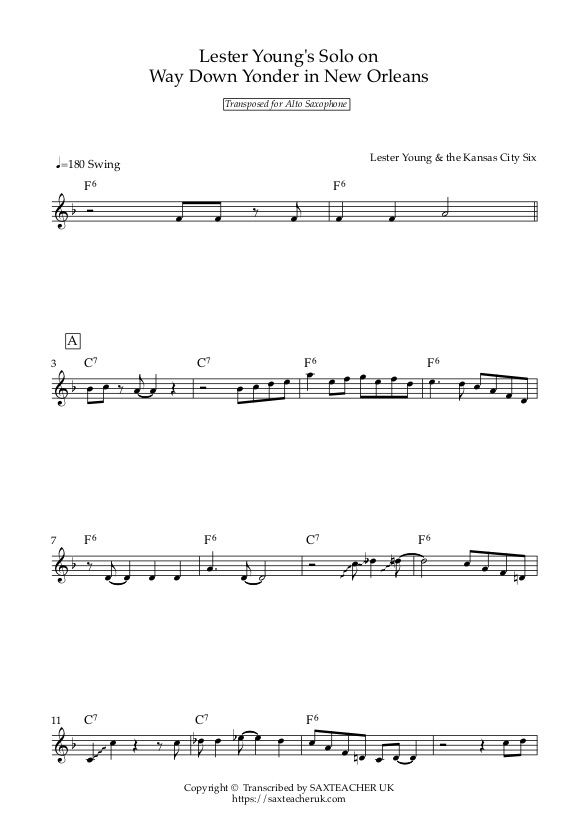
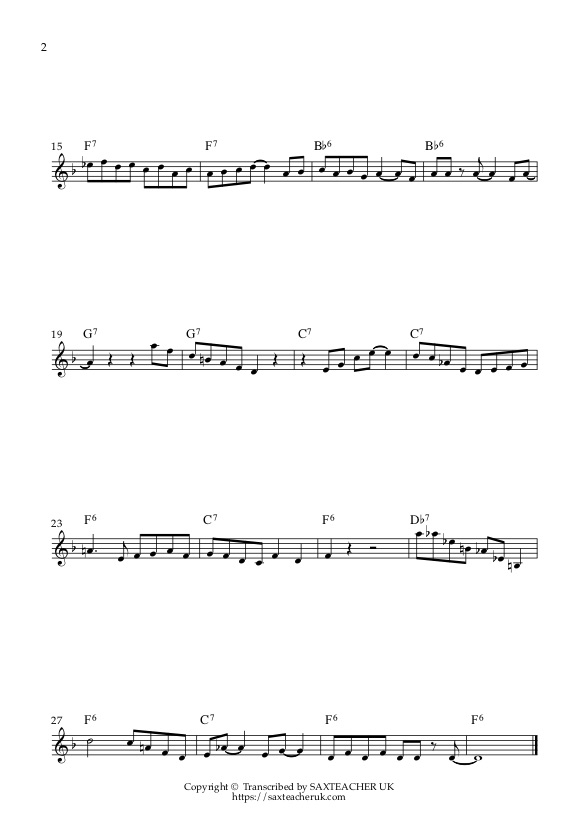
The full transcription is shown below. Study the score alongside the recording — focus on absorbing Lester's articulation and rhythmic feel, not just the pitches. Free PDF downloads for both tenor and alto saxophone are available beneath the score.

Page 1 of 2 Way Down Yonder in New Orleans — free Lester Young tenor saxophone transcription, page 1 of 2, showing the opening melodic phrases of the solo
Page 2 of 2 Way Down Yonder in New Orleans — free Lester Young tenor saxophone transcription, page 2 of 2, showing the concluding phrases and coda

How to Practise This Jazz Saxophone Transcription

Advice on Deeper Study

Go for depth, not speed — it doesn't matter how fast you learn it. Practise in shorter phrases, gradually making them longer. Really listen to and analyse the phrasing and articulation, and try to copy it exactly until you sound exactly like the recording.

Don't worry about tempo. Play it as faithfully as possible with perfect phrasing and articulation at a speed which is comfortable and relaxed. Learn the meaning behind each phrase: what is its history? What does it mean? What is the musical context? Understanding the harmonic and melodic logic behind Lester's choices will deepen your own jazz vocabulary.

Above all, try to imagine how Lester was feeling when he was playing this. Practise this feeling as you practise playing the solo. That's where the real magic of transcription study lies — not in the notes themselves, but in the intention and expression behind them. If you'd like help working through this solo, consider booking a saxophone lesson — working with a teacher can accelerate your progress enormously. You can also explore our tutorial hub for more guides on jazz improvisation, technique and transcription study.

Free PDF Downloads

All transcriptions and guides are available free of charge. Would you like to see a transcription that isn't on the site? Get in touch and request it!

Frequently Asked Questions

What is Way Down Yonder in New Orleans? +

Way Down Yonder in New Orleans is a popular standard written by Henry Creamer and Turner Layton in 1922. Lester Young's recording of the tune with the Count Basie Orchestra is one of the most celebrated versions, showcasing his beautiful melodic development, warm tone and subtle phrasing.

What makes Lester Young's sound special on this recording? +

Lester Young's sound on this recording has a honeyed warmth and remarkable consistency across the whole range of the instrument. His tone is lighter and more lyrical than other tenor players of the era, and his subtle use of ghost notes, half-tonguing and glissandos adds elegance and shape to his improvised melodies.

Is this transcription available for alto saxophone? +

Yes — the Way Down Yonder in New Orleans transcription is available as a free PDF in both Bb (tenor saxophone) and Eb (alto saxophone) transpositions. Both download links are in the Free PDF Downloads section above.

How should I practise a saxophone transcription? +

Start by listening to the recording many times before touching your saxophone. Then learn the transcription slowly, focusing on matching Lester Young's articulation and phrasing rather than just the notes. Go for depth, not speed — the goal is to absorb his style and vocabulary, not just learn the dots on the page.

Can I get help learning this solo with saxophone lessons? +

Absolutely. Working through a transcription like this with a teacher can make a huge difference — you'll get direct feedback on your tone, articulation and rhythmic feel, and guidance on how to apply Lester Young's vocabulary to your own playing. Get in touch to book a saxophone lesson in person or online.

What is a saxophone glissando and how do I play one? +

A glissando (or gliss) is a smooth slide between two notes, and it's a hallmark of Lester Young's style on this recording. The technique involves starting on the note below the target note and gradually lifting your finger to create a smooth pitch bend. Practise this away from the solo first, using only your fingers — avoid the 'lip-drop' habit. Once the finger technique is comfortable, you can add subtle embouchure adjustments to shape the glissando.

When was Way Down Yonder in New Orleans written? +

Way Down Yonder in New Orleans was written by Henry Creamer (lyrics) and Turner Layton (music) in 1922. It quickly became a popular jazz and Dixieland standard. Lester Young's celebrated recording with the Count Basie Orchestra was made in 1938 and remains one of the most studied versions of the tune.

What key is Way Down Yonder in New Orleans in? +

The Count Basie Orchestra recording of Way Down Yonder in New Orleans featuring Lester Young is in concert Bb major. For tenor saxophone (a Bb transposing instrument), the transcription is written in C major. The alto saxophone transposition is in G major.

SaxTeacher UK — Founder SaxTeacher UK Founder

SaxTeacher UK is a woodwind and piano teacher based in South East London. With 17 years of individual and group tuition experience. Get in touch for in-person or online lessons.

All author posts

Book a Lesson

Your information will be forwarded to me and I will get back to you as soon as I can.

Sax teacher London

Give me a call

+(44)7704 762 561

We are committed to protecting your privacy. We will never collect information about you.

Scroll