Skip to content
 Play Music, Express Yourself, Be Happy! 

SAX TEACHER UK

The Touch of Your Lips — Ben Webster Transcription

By SaxTeacher UK on 7 min read
SaxTeacher UK — author photo

Ben Webster was one of the supreme ballad players in the history of the saxophone — a musician whose warm, breathy tone and deeply expressive phrasing have never been surpassed. This article explores his life and playing, the celebrated 1959 session with Oscar Peterson that produced this recording of The Touch of Your Lips, and the solo itself: a study in time, feel and the art of melodic expression. The full transcription is available as a free PDF download for both tenor and alto saxophone.

Focus on Tone and Feel

Ben Webster's playing is inseparable from his sound — that warm, breathy tenor quality. Before studying the notes, listen carefully to his tone and the way he locks in with the rhythm section. It's the feel you're after, not just the pitches.

Master the Phrasing

Webster's phrasing techniques — note bends, smears, glissandos — are the heart of his style. These are learnt by ear, not from the page. Listen closely, copy exactly, and practise finding those 'biting points' slowly before bringing them up to speed.

Newsletter

Get Free Sheet Music & Tips

Tips, tutorials & new posts delivered to your inbox. No spam, unsubscribe any time.

We are committed to protecting your privacy. We will never collect information about you.

Ben Webster — Biography

The Brute and the Ballad Master

Benjamin Francis Webster was born in Kansas City, Missouri on 27 March 1909. He began his musical life as a pianist before switching to tenor saxophone in his early twenties, studying with Budd Johnson and absorbing the saxophone vocabulary of the great Coleman Hawkins. By the 1930s he had established himself as one of the most distinctive voices in jazz, working with Bennie Moten and Andy Kirk before joining Duke Ellington's orchestra in 1940.

His years with Ellington — from 1940 to 1943 — produced some of the most celebrated recordings in jazz history and cemented Webster's reputation as the pre-eminent ballad player on the instrument. His tone was extraordinary: on slow, sensuous ballads it was warm, breathy and intimate; on up-tempo pieces it could be raw and aggressive — qualities that earned him the nickname 'The Brute.' No other saxophonist inhabited both extremes with such conviction.

After leaving Ellington, Webster led his own groups and recorded prolifically through the 1950s and 1960s. He relocated to Europe in 1964, settling eventually in Amsterdam, where he became a beloved figure in the jazz community until his death in 1973. His European recordings, made with great rhythm sections and in relaxed, sympathetic settings, capture the full depth and warmth of his mature playing.

Ben Webster Meets Oscar Peterson

Verve Records, 1959

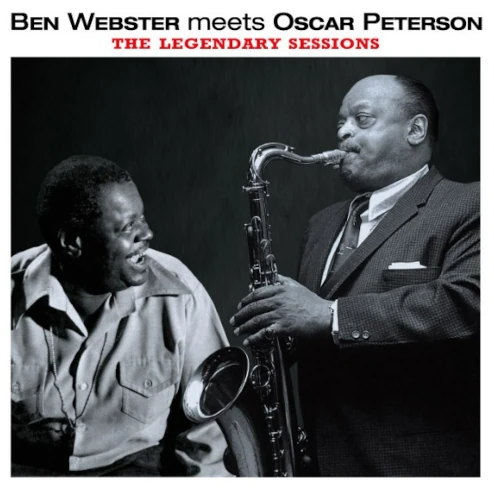
Recorded in 1959 for Verve Records, Ben Webster Meets Oscar Peterson is widely regarded as one of the finest small-group recordings in jazz. The session brings together two towering figures — Webster's massive, soulful tenor and Oscar Peterson's consummate piano — supported by Ray Brown on bass and Ed Thigpen on drums. The combination of such individual voices within such a polished rhythm section gives the album a rare sense of both intimacy and authority.

The Touch of Your Lips is one of the album's most celebrated tracks: a medium swing groove that allows Webster the space to stretch out, develop his melodic ideas fully, and demonstrate the complete range of his expressive technique. Ed Thigpen's conga-influenced drum groove on the track has become famous in its own right among drummers studying the art of swing comping.

Ben Webster Meets Oscar Peterson — album cover Buy the Album

Ben Webster's Time and Feel

Swing Spacing and Rhythmic Interplay

One of the great pleasures of this recording is hearing how Ben Webster locks in with the rhythm section, matching his swing spacing perfectly with Ed Thigpen's ride cymbal. This creates a strong, consistent rhythmic texture — a powerful platform for melodic development and group interaction. Pay close attention to this when listening: the way the soloist and rhythm section breathe together as a single unit is a central lesson of the recording.

When Ben plays across the beat — using triplets or by subtly stretching the time — this is his way of dramatically increasing tension and dramatic effect. These time stretches are impossible to write accurately on the page. Listen closely to how Webster plays them and copy exactly what you hear. This is where transcription study truly earns its value.

Phrasing and Expression

Note Bends, Smears and Glissandos

Ben Webster uses an infinite variety of phrasing techniques to accentuate his melodic playing. Like a great vocalist, he uses note bends and smears to create imaginative expressive effects — no two notes ever sound quite the same. Understanding how these effects are produced is essential to bringing the transcription to life.

Note bends: Webster blends notes frequently, often with intervals of a tone or semitone. If the bend leads into the note, start a semitone or tone below and gradually lift your finger. You will feel a 'biting point' when the note bends. Practise finding this spot. You can use your lip to accentuate the bend, but the main work is done with fingering. If the bend occurs at the end of a note, it is accomplished by a lip drop, bending the note downwards as it ends.
Glissandos: For intervals wider than a tone, coordinate the biting points of several notes as if playing a scale. Use your lip to smooth over note transitions, particularly when crossing the break. On descending glissandos, where adding fingers is clumsier, the lip plays a larger role. Experiment with this combination of fingering and embouchure to find the smooth, effortless quality that Webster makes sound so natural.

Ben Webster saxophone phrasing — note bends and glissandos from The Touch of Your Lips transcription

The Transcription — The Touch of Your Lips

Full Score — Ben Webster Tenor Saxophone Solo

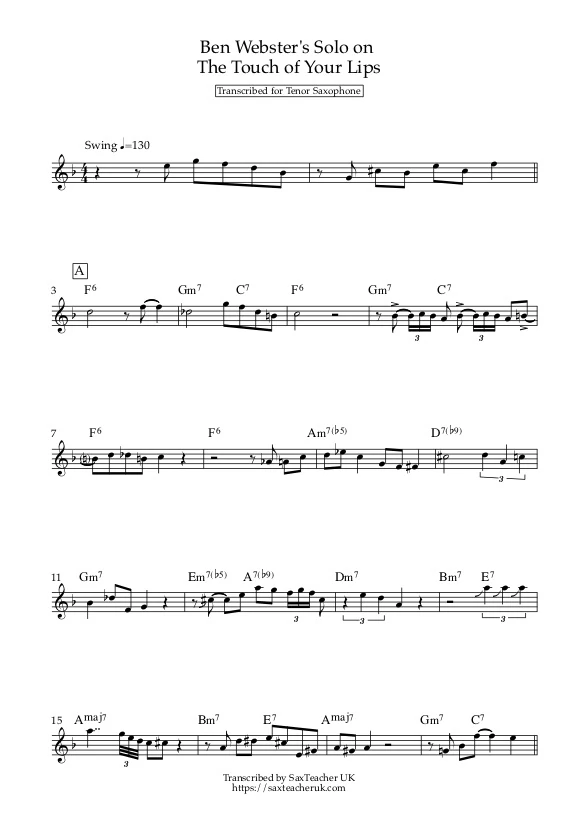
The full transcription is shown below. Study the score alongside the recording — focus on absorbing Webster's tone, articulation and rhythmic feel, not just the pitches. The bends, smears and time-feel nuances are where the real learning happens. Free PDF downloads for both tenor and alto saxophone are available beneath the score.

The Touch of Your Lips — Ben Webster tenor saxophone transcription, free PDF download

Free PDF Downloads

All transcriptions are available free of charge. Would you like to see a transcription that isn't on the site? Get in touch and request it!

Frequently Asked Questions

What recording is this Ben Webster transcription from? +

This transcription is taken from Ben Webster Meets Oscar Peterson, a landmark album recorded in 1959 for Verve Records. The session features Ben Webster on tenor saxophone with Oscar Peterson on piano, Ray Brown on bass, and Ed Thigpen on drums. The Touch of Your Lips is one of the album's most celebrated tracks.

Is this transcription available for alto saxophone? +

Yes — the transcription is available as a free PDF in both Bb (tenor saxophone) and Eb (alto saxophone) transpositions. Both download links are in the Free PDF Downloads section above.

How do I learn Ben Webster's note bends and glissandos? +

Note bends are primarily achieved through fingering — start a semitone or tone below the target note and gradually lift your finger to find the 'biting point.' The lip can be used to accentuate the effect, but the main work is done with the fingers. For glissandos wider than a tone, coordinate the biting points of several notes as if playing a scale, using the lip to smooth over note transitions — particularly when crossing the break.

How should I practise a saxophone transcription? +

Start by listening to the recording many times before touching your saxophone. Then learn the transcription slowly, focusing on matching Ben Webster's tone, articulation and phrasing rather than just the notes. Repetition is key — the goal is to absorb his style and vocabulary, not just learn the dots on the page.

Can I get help learning this solo with saxophone lessons? +

Absolutely. Working through a transcription like this with a teacher can make a huge difference — you'll get direct feedback on your tone, articulation and phrasing, and guidance on how to apply Webster's ballad vocabulary to your own playing. Get in touch to book a saxophone lesson in person or online.

SaxTeacher UK — Founder SaxTeacher UK Founder

SaxTeacher UK is a woodwind and piano teacher based in South East London. With 17 years of individual and group tuition experience. Get in touch for in-person or online lessons.

All author posts

Book a Lesson

Your information will be forwarded to me and I will get back to you as soon as I can.

Sax teacher London

Give me a call

+(44)7704 762 561

We are committed to protecting your privacy. We will never collect information about you.