Skip to content
 Play Music, Express Yourself, Be Happy! 

SAX TEACHER UK

Cherry Red Blues — Eddie Cleanhead Vinson Transcription

By SaxTeacher UK on 7 min read
SaxTeacher UK — author photo

Eddie 'Cleanhead' Vinson is one of the most underrated figures in the history of the alto saxophone — a musician who bridges the gap between the raw blues tradition and the sophisticated jazz that would follow. This article explores his life, the fascinating history of Cherry Red Blues and its place in the jump blues and R&B canon, and the solo itself: a masterclass in blues phrasing, upper-register power and vocal saxophone expression. The full transcription is available as a free PDF download for alto saxophone.

Sing Before You Play

Cleanhead Vinson was first and foremost a vocalist. Before you pick up your saxophone, learn to sing this solo — including his blues inflections and bends. The connection between his voice and his instrument is the whole point.

Listen for the Lineage

As you study this solo, listen out for the echo of Sidney Bechet in Cleanhead's upper register. Then compare his approach with Earl Bostic on Hurricane Blues. Tracing this lineage forwards to Cannonball Adderley is a revelation.

Newsletter

New Solo Transcriptions

Get a short email whenever a new solo transcription goes up. No spam, unsubscribe any time.

We’ll only email you new transcriptions and tutorials, and you can unsubscribe any time. See our Privacy Policy.

Need a solo or song that isn’t here? I can transcribe it for you — piano, sax & jazz solos, lead sheets or horn sections & big band, in Concert, B♭ and E♭.

Eddie Cleanhead Vinson — Biography

The Voice from Houston

Eddie Vinson was born on 18 December 1917 in Houston, Texas, into a musical family and a city already steeped in the blues tradition. He took up the alto saxophone as a teenager and showed an instinctive flair for blues phrasing — a quality that would define his playing throughout his career. His nickname 'Cleanhead' came from a botched hair-straightening treatment in the 1940s that left him permanently bald, a detail he wore with characteristic good humour.

Vinson came up through the Texas blues scene before joining Cootie Williams' big band in New York in 1942, where he found his national audience. His double role as alto saxophonist and blues vocalist made him a uniquely compelling bandstand presence. He could hold a crowd with a sung chorus and then turn the same emotional intensity loose on his instrument, the phrases flowing from one medium to the other with total naturalness.

After leaving Williams he led his own groups through the late 1940s and 1950s, recording prolifically in the blues and R&B idiom. Though he fell somewhat into obscurity during the 1960s, later collaborations with jazz musicians including Cannonball Adderley brought his work to a new generation of listeners. He continued to perform right up until his death in 1988, leaving behind a body of work that remains deeply undervalued — and one that repays careful study in saxophone lessons as much as it does in private practice.

History of Cherry Red Blues

From Kansas City to New York

The title 'Cherry Red' has roots deep in the Kansas City blues tradition. Pete Johnson and Big Joe Turner — the great boogie-woogie pianist and blues shouter — recorded a song called Cherry Red as early as 1938 for Vocalion Records. Turner's loose, declamatory vocal style and the churning boogie rhythm underneath it were landmarks of the Kansas City sound that would eventually sweep through New York's jazz and dance halls.

When Cootie Williams brought Cleanhead Vinson into his orchestra in 1942, the jump blues was in full swing. Big bands were the popular music of the era, and the savvier bandleaders had learned to combine jazz sophistication with the gut-punching directness of the blues. Vinson's Cherry Red Blues, recorded in 1944 for Hit Records, borrowed the title and spirit of that Kansas City tradition but recast it entirely — Cleanhead's vocal style drawing on country blues, gospel and the Texas blues, while his alto saxophone solo gave the recording a second voice of remarkable intensity.

The record was a commercial success, establishing Vinson as a star vocalist-instrumentalist in the same mould as Louis Jordan, whose jump blues combo sound was dominating the R&B charts. Unlike Jordan, however, Vinson was also a genuinely advanced alto saxophonist — someone whose roots in jazz ran deep even as he embraced the commercial blues format.

Cootie Williams and His Orchestra

The Recording Context, 1944

Charles 'Cootie' Williams was one of the great trumpet voices in jazz — famous above all for his work with Duke Ellington's orchestra from 1929 to 1940, where his plunger-mute playing was so distinctive that Ellington wrote 'Concerto for Cootie' specifically for him. By the time Williams formed his own orchestra in the early 1940s, he had assembled an impressive band that blended jazz virtuosity with the crowd-pleasing power of the jump blues.

The orchestra that recorded Cherry Red Blues in 1944 was a well-drilled big band, and the rhythm section provided exactly the kind of solid, swinging foundation that jump blues required. Vinson's vocal and saxophone features were the centrepieces of the band's live performances, and the recordings from this period capture a crucial moment in the evolution of American popular music — the point at which jazz sophistication and blues feeling were most perfectly and commercially fused.

Eddie Cleanhead Vinson — Cherry Red Blues, Cootie Williams Orchestra Watch on YouTube

About the Cherry Red Blues Solo

Vocal Inflections on the Alto Saxophone

Even through the limitations of 1944 recording technology, the raw power in Cleanhead's alto sound is unmistakable. This is a performance that demands physical presence — there is nothing subtle or restrained about it. The upper register playing in particular is striking: you can hear, in the overtone-rich, clarinet-like quality of those high notes, the influence of Sidney Bechet — the first great innovator of the saxophone and clarinet in jazz, whose soprano playing set an early template for expressive upper-register work that many alto players absorbed.

What makes this solo especially instructive is the directness of the connection between Vinson's singing and his playing. On Cherry Red Blues, he delivers a vocal performance rich in blues and country inflections — bends, glides, blue notes, the kind of raw expressivity that comes from a musician who grew up surrounded by the music. Many of those same inflections are then transposed onto the saxophone, enriching the emotional impact of his instrumental solo in a way that purely technical approaches cannot replicate.

The lesson for any saxophonist studying this transcription is clear: learn to sing the solo before you play it. Better still, learn to sing Cleanhead's vocal chorus too, and then play his saxophone solo with the same intention. This is the closest you can get to the source of his phrasing.

The Transcription — Cherry Red Blues

Full Score — Eddie Cleanhead Vinson Alto Saxophone Solo

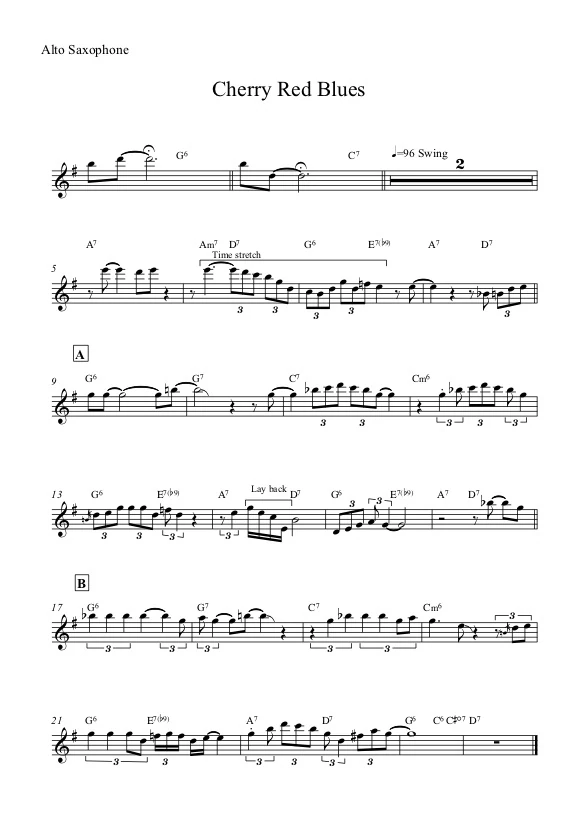
The full transcription is shown below. Study the score alongside the recording — focus on Cleanhead's articulation, his use of vibrato, and the blues inflections that give the solo its character. A free PDF download for alto saxophone is available beneath the score.

Cherry Red Blues saxophone transcription — Eddie Cleanhead Vinson alto saxophone solo score, 1944
Cherry Red Blues — Eddie Cleanhead Vinson alto saxophone solo. Recorded 1944 with the Cootie Williams Orchestra.

The Blues Saxophone Lineage

Bechet → Bostic → Cleanhead → Cannonball

One of the most rewarding aspects of studying Cleanhead Vinson is the way it opens up a deeper understanding of the alto saxophone's development. Listen carefully and you can trace a direct lineage: Sidney Bechet's soprano playing — full of vibrato, blues feeling and upper-register power — fed into the Texas and New Orleans alto saxophone tradition. Cleanhead and his contemporary Earl Bostic both absorbed these lessons and made them their own.

Compare Cleanhead's solo here with Bostic's Hurricane Blues. The palm-key upper register is enormous in both — fat, powerful, perfectly in tune, full of depth and colour. Both men were seeded by Bechet, and both took the lessons that spoke personally to them. The difference is one of character: Bostic's approach is more muscular and extroverted, Cleanhead's more rooted in the blues vocal tradition.

This lineage then flows forward. Bostic was a formative influence on Charlie Parker; Cleanhead was a corollary influence on Cannonball Adderley. Studying and unpicking this beautiful historic lineage is not merely an academic exercise — it gives you a practical understanding of why the music sounds the way it does, and opens up a rich vocabulary for your own playing. Browse the full transcriptions library to follow this lineage further. The dots on the page only carry you so far. The lineage takes you the rest of the way.

Free PDF Downloads

All transcriptions and guides are available free of charge. Would you like to see a transcription that isn't on the site? Get in touch and request it!

Frequently Asked Questions

What is Cherry Red Blues? +

Cherry Red Blues is a jump blues recording made by Cootie Williams and His Orchestra in 1944, featuring Eddie Cleanhead Vinson on vocals and alto saxophone. The title draws on an earlier Kansas City blues tradition established by Big Joe Turner and Pete Johnson, but Vinson's version became a hit in its own right — showcasing his searing alto tone and raw blues-preacher vocal delivery.

Who was Eddie Cleanhead Vinson? +

Eddie 'Cleanhead' Vinson (1917–1988) was an American alto saxophonist, blues vocalist and composer from Houston, Texas. He earned his nickname after a hair-straightening accident left him permanently bald. He played with the Cootie Williams Orchestra in the 1940s before leading his own groups, and was a vital link in the lineage connecting the early blues-influenced alto saxophone style to postwar R&B and jazz. His work was later championed by Cannonball Adderley, who recorded with Vinson and helped bring him to a new generation of listeners.

Is the Cherry Red Blues transcription available for tenor saxophone? +

The transcription is currently available as a free PDF for alto saxophone (Eb). Tenor players can transpose it up a whole tone. Get in touch if you'd like a Bb transposition added to the page.

How should I practise a saxophone transcription? +

Start by listening to the recording many times before picking up your saxophone — ideally until you can sing the solo from memory. Then learn it slowly, focusing on Cleanhead's articulation, vibrato and blues inflections rather than just the pitches. With a blues-rooted solo like this one, the goal is to absorb his vocal approach to the instrument, not just to learn the notes on the page.

Can I get help learning this solo with saxophone lessons? +

Absolutely. Working through a transcription like this with a teacher can make a real difference — you'll get direct feedback on your tone, blues phrasing and articulation, and guidance on connecting Vinson's vocabulary to your own playing. Get in touch to book a saxophone lesson in person or online.

Are there other free alto saxophone transcriptions on this site? +

Yes — the free transcriptions library includes solos spanning blues, bebop, hard bop and beyond, all available as free PDF downloads for alto and tenor saxophone. New transcriptions are added regularly.

SaxTeacher UK — Founder SaxTeacher UK Founder

SaxTeacher UK is a woodwind and piano teacher based in South East London. With 17 years of individual and group tuition experience. Get in touch for in-person or online lessons.

All author posts

Book a Lesson

Your information will be forwarded to me and I will get back to you as soon as I can.

Sax teacher London

Give me a call

+(44)7704 762 561

We use your details only to reply to your enquiry and arrange lessons. We never sell or share them. See our Privacy Policy.

Scroll